

Ruminations on loving in Ireland by an gay immigrant
This article was first published in ‘Airmid’s Journal’, edition Lughnasa 2024: Aiteach
There is a process that immigrants like myself (blessed to have gone and gotten themselves where they wanted to be) go through after we’ve re-rooted ourselves in our new land. Where the experience of the daily realities of your new home begin a complex conversation with all you thought you knew about it, even if you had visited it many times before. The projections and romantic idealisations that got you there slowly give way to a richer, if tougher awareness of the place you chose to call home. Once this place becomes your new setting in any official way, you’re not traveling anymore. You’re living there.
As an Argentinian gay man moved to Ireland, my genetic Italian fondness for rest, leisure and guiltless forms of expression; alongside my Latin-american culture of warmth and physical affection, contrasted rather starkly with the local ways of carrying about. With what I understand now as a certain Irish tendency for guilt towards pleasure, stillness and explicit acts of affection; a generational, handed-down discomfort or fear of allowing themselves, and sometimes others, the ‘good stuff’. I remember being so puzzled, before I understood more, at how my Irish friends would make ‘notions’ out of things that my Italo-Argentinian way of life taught me to always go for, simply cause I well damned deserve it. Where I come from, this stands true for a second slice of cake… and also for love.
When it came to dating Irish fellas, this cultural contrast took even deeper and rougher edges; which would often leave me puzzled and confused after many beautiful Irish men would repeatedly weave a spell of charm around me for a while and then disappear into the mist, as if taken by the fairy host. My Irish gay bros would reassure me that it was just the auld ‘come’ere-to-me-fuck-off’ style of Irish gay dating, and that sure haven’t they’ve been at it themselves one time or another. While really not comforting at all, this served to safe-keep my sense of self-worth for a while, but after finding myself there way too many times, I was led to one of two possibilities: a) I may just be a shite date; or b) there had to be some understandable, logical reason that was completely unrelated to me. Hopefully.
Eventually, I learned and understood more about ancient, medieval and modern Irish society, not only from books but also from living and working amongst the people of Ireland, calling many of them family, and some things began to make sense. You don’t need to be an expert in Irish history to understand how centuries of cultural, religious and political colonialism can and will plunge a native people in trauma, shame and guilt; change their moral attitudes towards what is biologically natural and was considered healthy once upon a time.
Changes in the native language are an accurate way to trace this – take a type of sexual activity that anyone can enjoy, is healthy when practised in moderation and hurts no one: masturbation.
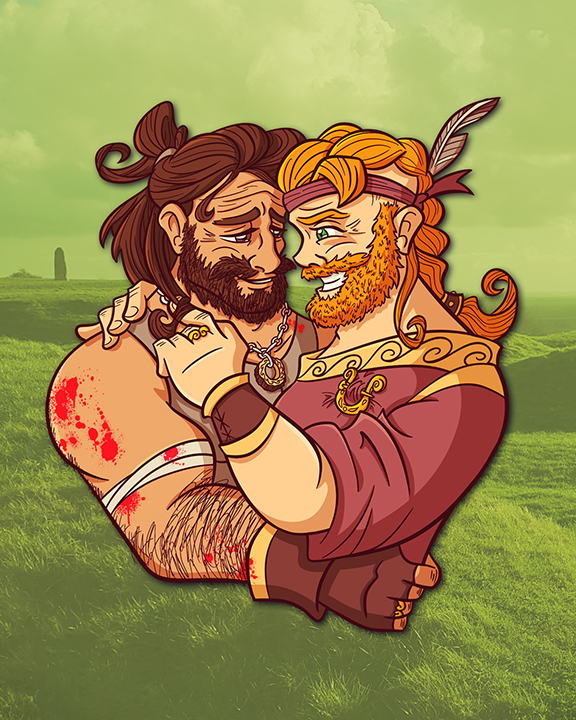
In his book ‘Terribly Queer Creatures’, Dr. Brian Lacey (check out his article in this journal for a study of Irish homosexuality in history) points out that the word for ‘masturbation’ in Old Irish (which was spoken until about 900 AD) is ‘lámhcairdeas’. This translates back to English literally as ‘friendship of the hand’, and to me it sounds sweet and precise; an amiable disposition towards an aspect of sexuality that later societies found more problematic.
But! A thousand years later, in an Irish dictionary from 1895, ‘masturbation’ has become ‘féintruailliú’, which translates as ‘self-pollution’. The contrast is kinda funny, and also really awful. The contrast is too strong and he time too short for the change to have happened naturally.
In 2001, during my 4th year at high school, everyone found out I was gay, and it was 100% alright. I became a celebrity. All the lads in my year gathered together to assure me that no one would bully me, that I was safe and that it was all good. Early 2000’s Buenos Aires wasn’t necessarily some utopia of progress and tolerance, but my story is not that rare there. I wonder how many 16 year old gay lads in Ireland at the time would’ve had a similar experience of acceptance and inclusion in that most complex and most awkward of teenage times. I’d wager not too many.
Only after my experiences in Ireland do I fully appreciate how ridiculously privileged I was to enjoy such freedom to be. Even if it wasn’t always as easy, and while many others weren’t always as lucky not be shunned by loved ones, I was ultimately always led to believe by family, friends and school that there was absolutely nothing wrong with being who I am. That my feelings are valid and okay, even when I can’t see it. That self-love is a birthright, even if it takes me a whole life to get there.
It is a most heart-breaking thing, that I’ve witnessed many times, to see a good Irish man (you know the ones) struggling and failing to deem himself worthy of being loved for who he is, even when you’re there next to him, extending your hand and feeling that all would really, really be grand if he just feckin’ took it. And while close-heartedness is a general symptom of our sick modern times, and not an exclusively Irish, male or queer issue; this wound seems more bespoke to me than others, specific to a generation of Irish men raised by people for whom love was made to be something forbidden, full of shame and sin.
I don’t have any clues on how to fix this, but I do see healing. I see a younger generation of Irish people slowly and kindly remedying the hurts of the past. Through cultural expansion and re-invention, through artwork, self-publications, activism and politics, through visibility, communities and ceremony.
And this gives me hope. Hope that one day I might be courted by an Irish man who’s open-hearted, and knows what his ancestors surely knew to be a central, universal and eternal truth: that being loved, by yourself, others or even your own hands, is and always has been an act of friendship, and never pollution.
 deercún